Air Purifier for Dust NZ: Why Dust Keeps Coming Back and What to Look For Before Buying
Air Purifier for Dust NZ: Why Dust Keeps Coming Back and What to Look For Before Buying
You gave the house a proper clean on Saturday. Shelves were wiped, floors vacuumed, bedding changed and the lounge finally looked finished.
By Tuesday, sunlight across the coffee table reveals another fine layer. Before blaming the cleaning routine or buying the first machine labelled for dust, it helps to treat the problem as a small household mystery: where is the dust entering, what is creating it, and how much is still airborne long enough to reach a purifier?
Direct answer: A correctly selected and maintained air purifier can help reduce airborne dust that reaches the unit. It cannot remove dust already settled on furniture, flooring, carpet or bedding, and it cannot stop an ongoing source. Results depend on room fit, particle filtration, airflow, runtime, placement and filter maintenance, while cleaning and source control remain essential.1
Start with a seven-day dust diary
Dust becomes easier to understand when you record where it returns and what happened beforehand. Choose one or two surfaces that are easy to inspect, then use the same surfaces for a week.
| Day | Room and surface | How quickly it returned | Nearby windows, doors or vents | Activities and nearby materials | Appearance |
|---|---|---|---|---|---|
| 1 | Room plus shelf, sill or table | Hours or days | Open, closed, draughty or frequently used | Cooking, cleaning, pets, bedding, carpet, curtains or renovation work | Coarse, fibrous or very fine |
| 2 | |||||
| 3 | |||||
| 4 | |||||
| 5 | |||||
| 6 | |||||
| 7 |
These visual clues can guide practical checks, but they are not laboratory particle identification. Household dust is a mixture and can include material brought in from outdoors, fibres, skin and hair, pet-related particles, pollen and particles created by everyday activities.2
Four dust signatures that can narrow the search
1. Entry-edge or outdoor-ingress dust
A heavier line on window sills, door tracks, the entry floor or furniture beside an open window may point towards outdoor dust being blown or tracked inside. Check door seals, frequently opened windows, shoes, pets entering from outside and vents that draw air through dusty areas.
2. Soft-furnishing, textile or pet-related shedding
Fibres around beds, sofas, curtains, pet beds or carpeted rooms may suggest local shedding. Bedding changes, vigorous vacuuming, pet movement and opening curtains can also put settled material back into the air for a time.
3. Activity-linked particles
A visible return after frying, cleaning, sweeping, moving furniture or DIY work may be connected to that activity. Cooking and some cleaning or combustion activities can generate indoor particulate matter, while walking and vacuuming can resuspend settled dust.2
4. Whole-room circulation and resettling
A fine, even film across several surfaces can indicate material that is circulating, settling, being disturbed and settling again. Fans, heat pumps, foot traffic, open-plan airflow and a purifier placed too far from the priority area can all affect this pattern.
None of these signatures is a definitive scientific diagnosis. They are prompts for checking likely pathways before choosing equipment.
The boundary that matters: airborne dust versus settled dust
An air purifier works only on air that reaches its intake. Some fine particles may remain suspended or be repeatedly stirred up, while heavier material can settle before the purifier captures it.
| What this may help with | What it does not solve |
|---|---|
| Airborne particles that pass through the unit | Dust already sitting on shelves, floors and furniture |
| Fine particles that continue recirculating in one room | Dust stored in carpet, bedding and upholstery |
| Particle reduction while the purifier runs consistently | Continuing entry, shedding or dust-producing work |
| Supplementary filtration after obvious sources are reduced | Cleaning, repairs, extraction or moisture problems |
| A priority room when the unit is suitable for that space | Whole-home results from one undersized room unit |
The useful distinction is not whether the home has dust. Every lived-in home does. The question is whether enough of the problem is airborne, in one manageable room, for filtration to make a practical difference alongside source control.
Match the dust clue to the first action
| Dust clue | Possible pathway | First action | Supporting purifier role | When another solution comes first |
|---|---|---|---|---|
| Grit or heavier dust near the entry | Shoes, pets, gaps or open doors | Use mats, remove shoes, clean tracks and inspect seals | Capture finer material that becomes airborne nearby | Repair obvious gaps or uncontrolled entry first |
| Dust line on window sills | Outdoor air through open or leaky windows | Adjust opening times and clean frames with a damp cloth | Run in the priority room when windows are closed | Address damaged seals or ongoing building work nearby |
| Fibres around beds, sofas or pet areas | Bedding, carpet, curtains, upholstery or pet shedding | Wash bedding, groom pets and vacuum reservoirs regularly | Reduce airborne particles disturbed by movement | Deep cleaning or replacing a damaged textile reservoir may matter more |
| Dust appears after cooking | Cooking particles and air movement from the kitchen | Use effective extraction vented outdoors where available | Supplement particle filtration in an adjacent room | Repair or improve poor extraction first |
| Dust spikes after sweeping, vacuuming or moving furniture | Settled dust being resuspended | Damp-dust, use a suitable vacuum and clean from high to low | Run during and after cleaning if the instructions allow | Remove the large settled reservoir before judging the purifier |
| Fine dust during sanding, drilling or renovation | Active work source | Contain the work zone and use suitable local extraction and cleanup | Only a secondary support outside the controlled work area | Worksite dust controls and professional advice come first |
| Dust with persistent dampness or visible mould | Moisture problem plus biological material | Find and fix the moisture source | May filter some airborne particles after the source is addressed | Moisture repair and appropriate mould cleanup come first |
The US EPA places source reduction and clean-air ventilation ahead of filtration, describing portable air cleaning as a useful supplement rather than a replacement.1
A dust-specific buying pathway
This is not a general best-product checklist. Use the branches below to decide whether a purifier fits the dust problem you have observed, then compare suitable room units in the Purifiers air-purifier collection.
Branch 1: Is the concern airborne dust or mostly surface debris?
- Mostly coarse debris and fluff: improve entry control, vacuuming, textile care and damp dusting first.
- A fine film that returns after movement or cleaning: source control still matters, but a room purifier may help with the portion that stays airborne long enough to reach it.
- An active dust source: control the source before buying a purifier as the main solution.
Branch 2: Which single room deserves priority?
Choose the room where the dust pattern is most consistent or where you spend the most time. Portable units are generally designed for a room or defined area, not an entire home from one corner.1 Keep calculations brief here, then use our NZ air purifier room-size guide to compare room volume with published performance information.
Branch 3: Can the unit handle coarse material before the fine-particle stage?
A washable or replaceable coarse-particle pre-filter can intercept hair, fluff and larger dust before they load the main particle filter. Check how it is cleaned, how often it needs attention and whether the instructions allow washing.
Branch 4: Is there a suitable high-efficiency particle stage?
For household dust, the main technical priority is a filter designed for airborne particles. HEPA is a recognised high-efficiency particle-filter type, but filter efficiency alone does not guarantee a whole-room result. Air still needs to reach the unit and pass through the filter.3
Branch 5: Is dust CADR independently available?
CADR is a tested clean-air delivery measure that combines airflow and particle-removal performance, with separate values possible for dust, smoke and pollen. A verified dust CADR is useful when available. Manufacturer airflow, fan airflow and maximum purification capacity are different specifications and should not automatically be treated as CADR.4
Branch 6: Will the household actually run it?
Check noise at the fan speed you expect to use, not only the quietest setting. Higher fan speeds and longer runtime generally move more air through the filter, so a unit that is tolerable during sleep, work or television time is more useful than one that stays switched off.1 Placement also matters, so review our NZ home placement guide before judging performance.
Branch 7: Can you maintain it locally?
Confirm that replacement filters are available in New Zealand, note their cost, and decide whether the cleaning and replacement routine is realistic. A loaded filter can reduce airflow and performance. Our air purifier filter replacement guide explains the general maintenance questions to ask, while the product manual remains the authority for a specific unit.
For a broader comparison across smoke, allergy-related particles and room types, use the best air purifier NZ buying guide once you have diagnosed the dust pathway. For this problem, start with the dust source rather than a broad ranking.
How Dust Moves Through Therapy Air's Five-Filter Stack
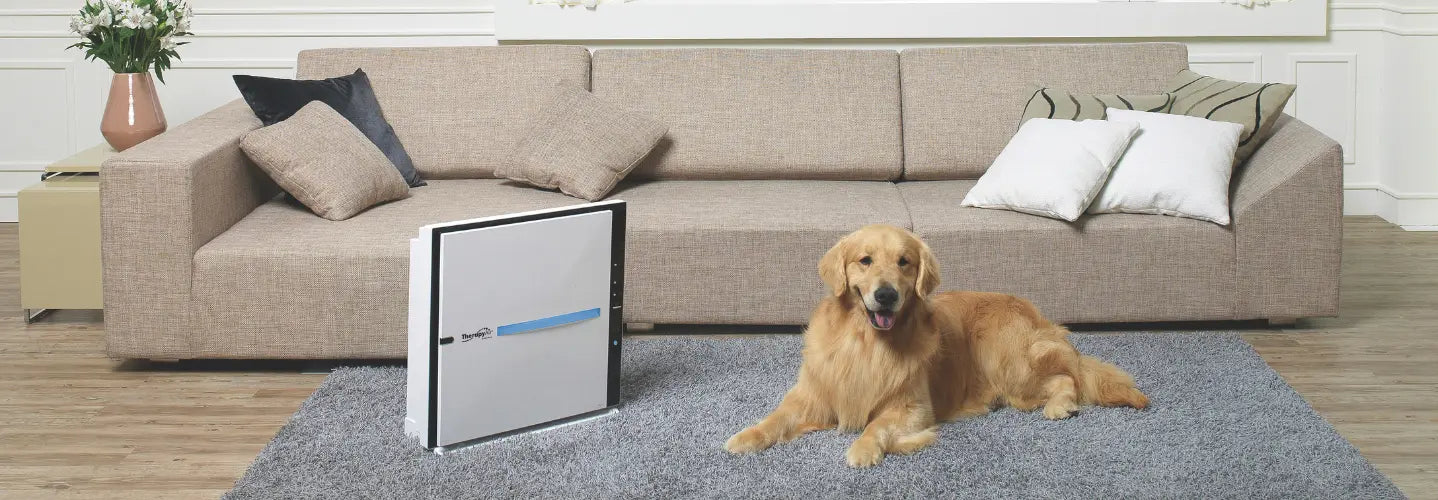
The manufacturer lists five filter stages for Therapy Air Ion. They do not all perform the same job, and five stages do not mean that all household dust will be removed.
- Antistatic filter: This is the larger-dust, hair and coarse-debris pathway. It helps protect the stages behind it from material that can be intercepted earlier.
- Antibacterial filter: The manufacturer describes this as an additional layer for smaller dust and pollen and as protection for the HEPA stage. We would treat that as the manufacturer-listed role rather than assume it provides the same fine-particle performance as the HEPA filter.
- HEPA filter: This is the key fine-particle stage in the listed stack. Its practical result still depends on airflow through the unit, room fit, runtime and filter condition.
- Anti-allergenic filter: This is best described here only as an additional speciality layer. It should not be presented as a substitute for source control, cleaning or medical care.
- Activated-carbon filter: This stage is mainly relevant to odours and certain gases. It is not the primary dust-capture layer.
Manufacturer-listed specifications that matter for this decision include 47 W power, a listed noise range of 21 to 46 dB, and a maximum purification capacity of 328 m3/h. The 328 m3/h figure is not presented as AHAM CADR, so it should not be labelled as independently verified dust CADR. The manufacturer also requires original filters to be replaced at least annually for the extended warranty conditions and maintenance record.5
Run a fourteen-day validation check
After source-control changes or after setting up a purifier, use a simple before-and-after household observation rather than relying on one glance in bright sunlight.
- Choose one room and keep the door position reasonably consistent.
- Choose one repeatable test surface, such as a dark shelf or glass-topped table.
- Clean that surface in the same way at the start of each comparison period.
- Record when windows and doors were open.
- Record purifier runtime and the fan setting used.
- Note unusual activities such as vacuuming, cooking, visitors, pet grooming, sanding or moving furniture.
- Compare how quickly visible dust returns over the first seven days and the second seven days.
This is a household observation method, not a laboratory test. Visible dust is not an accurate measurement of PM2.5, and small changes in light, cleaning or activity can alter what you see. No result is guaranteed. The aim is to learn whether the chosen setup changes the return pattern enough to be useful.
When an air purifier should not be the first purchase
- Active renovation dust: containment, local extraction, appropriate protective equipment and thorough cleanup come first.
- Obvious gaps or uncontrolled outdoor entry: repair the entry pathway before asking a room unit to keep up.
- Poor kitchen or bathroom extraction: fix or improve extraction where practical.
- Persistent dampness or mould: address the moisture source and use appropriate cleanup or professional help.
- Large reservoirs in carpet, bedding or upholstery: cleaning, washing or replacement may have more immediate value.
- Basic cleaning or repair needs: a purifier cannot substitute for removing settled dust or fixing the source.
Frequently asked questions
Do air purifiers help with dust?
Yes. A correctly sized and maintained air purifier can help reduce airborne dust that passes through its particle filter. It will not remove every particle, stop a continuing dust source or replace cleaning.
Why does dust keep coming back after cleaning?
Dust can keep returning because outdoor material is entering, textiles or pets are shedding, household activities are creating particles, or settled dust is being stirred up and resettling. A short dust diary can help identify the strongest pathway.
Can an air purifier remove dust already on furniture?
No. An air purifier cannot lift and remove dust that has already settled on furniture, flooring, carpet or bedding. That dust needs suitable cleaning, although some of it may become airborne again and then pass through a purifier.
What type of air purifier is best for household dust?
Look for a unit suited to the priority room, a coarse-particle pre-filter, a suitable high-efficiency particle stage, credible airflow or independently verified dust CADR where available, manageable noise and locally available replacement filters.
Is a HEPA filter good for dust?
Yes. A HEPA filter is designed for high-efficiency capture of airborne particles, including dust that reaches the filter. Whole-room performance still depends on airflow, room fit, runtime, placement and maintenance.
Why is my room still dusty with an air purifier?
The unit may be too small, run too briefly, use a low fan setting, sit in a blocked position or have loaded filters. The room may also have an ongoing source, and visible settled dust still needs to be cleaned.
Does an air purifier help with dust mites or only airborne particles?
An air purifier does not eliminate dust mites living in bedding, carpet or upholstery. It may help reduce airborne particles and mite-related material that reaches the filter, while washing bedding, cleaning reservoirs and managing moisture remain important.
How long should an air purifier run for dust?
Run it consistently enough to filter the room air, especially while the room is occupied or dust-producing activity is occurring. Longer runtime and higher practical fan speeds generally filter more air, but follow the manufacturer instructions and choose a noise level your household will maintain.
Next steps
First, reduce the obvious dust sources. Then choose one priority room, compare particle filtration and airflow, check noise at a usable setting, and confirm local replacement-filter availability. Once the pathway is clear, use the collection to review options that fit the room and maintenance routine.
References
- US EPA: Guide to Air Cleaners in the Home
- US EPA: Sources of Indoor Particulate Matter
- US EPA: What Is a HEPA Filter
- AHAM Verifide: Air Filtration Standards
- Therapy Air Ion manufacturer-listed filter stages, specifications and warranty conditions
General information only. Air filtration may support a cleaner indoor-air routine but does not replace source control, ventilation, cleaning, repairs or qualified advice for persistent health concerns.